
AI Data Center Cooling Radiator
Artificial intelligence is changing how businesses operate, from machine learning and data analysis to generative AI and advanced computing. Behind these technologies are powerful servers that process large amounts of data and generate substantial heat during operation. Managing this heat is essential for maintaining system stability, protecting hardware, and supporting reliable performance.
An AI data center cooling radiator can play an important role in a liquid cooling system by helping transfer heat away from circulating coolant and release it into the surrounding environment. As computing workloads become more demanding, data center operators are paying closer attention to cooling capacity, airflow, water circulation, and long-term operating costs.
Bharat QuantMine (BQM) specialises in hydro radiators and hydro machine racks for cryptocurrency mining applications. Its experience with industrial cooling equipment provides a useful starting point for understanding radiator-based heat management, although AI server installations require their own technical compatibility and capacity checks.
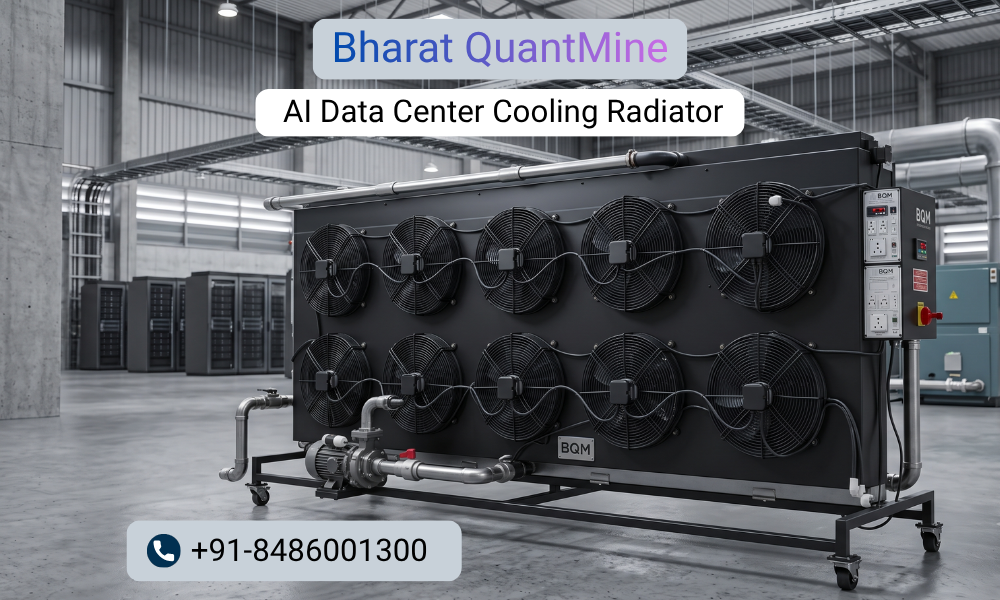
What Is an AI Data Center Cooling Radiator?
An AI data center cooling radiator is a heat-exchange component used in a cooling arrangement designed to remove heat generated by computing equipment.
AI servers often contain high-performance processors, graphics processing units (GPUs), memory, and other components that operate under demanding workloads. When these systems run continuously, heat must be removed at a rate that matches the thermal load.
In a liquid cooling arrangement, coolant absorbs heat from designated components or heat exchangers and carries it towards a radiator or another heat rejection unit. The radiator transfers that heat to the surrounding air, usually with the help of fans.
The exact design depends on the cooling architecture. Some facilities use direct-to-chip liquid cooling, while others use rear-door heat exchangers, facility water loops, or combinations of air and liquid cooling. A radiator must be selected according to the requirements of the complete system rather than its physical size alone.
Why AI Data Centers Need Better Heat Management
AI computing infrastructure can create concentrated heat loads, particularly when multiple high-performance servers operate together. Conventional room cooling may not be sufficient or economical for every high-density installation.
A properly engineered cooling system helps address several practical challenges.
- Managing High Thermal Loads
Cooling equipment must remove the heat generated by servers under realistic operating conditions. If the heat rejection system is undersized, coolant temperatures may rise and equipment may struggle to maintain its required operating range.
- Supporting Consistent Operation
Temperature stability matters when servers run intensive workloads for extended periods. Effective cooling helps maintain the environmental conditions specified by the equipment manufacturer.
- Improving Cooling Efficiency
Fans, pumps, heat exchangers, and control systems all consume energy. Selecting suitable equipment and managing airflow and coolant flow can help avoid unnecessary energy use.
- Preparing for Future Expansion
Data centers often increase computing capacity over time. Cooling infrastructure should therefore account for planned server additions, available electrical power, facility space, and future heat loads.
How Does a Liquid Cooling Radiator Work?
A radiator transfers heat from a circulating fluid to the surrounding air. Its performance depends on several factors, including heat-transfer surface area, coolant flow rate, inlet temperature, ambient temperature, airflow, and the temperature difference between the coolant and the air.
A typical radiator-based cooling arrangement includes the following components:
- Heat source: AI servers or other computing equipment that generate heat.
- Coolant circuit: Pipes and pumps that move fluid through the cooling loop.
- Heat exchanger: Transfers heat from the equipment or coolant circuit.
- Radiator and fans: Release heat into the surrounding air.
- Monitoring and controls: Track temperatures, pressure, flow, and equipment status where supported.
Not every AI data center uses the same arrangement. For example, a radiator connected to a secondary coolant loop may receive heat from a liquid-to-liquid heat exchanger rather than directly from server cooling plates.
This distinction is important because a radiator suitable for one application may not be suitable for another without changes to the system design.
Important Factors When Choosing an AI Data Center Cooling Radiator
Selecting the right radiator requires more than comparing dimensions or fan specifications. Data center operators should evaluate the complete operating environment.
Cooling Capacity
Start by calculating the heat that the system needs to reject, expressed in kilowatts (kW). Capacity should be established using the expected computing load and the required operating temperatures.
Ask the supplier for documented performance data under specified ambient and coolant conditions. A capacity figure without test conditions can be misleading.
Ambient Temperature
The surrounding air temperature affects how effectively a radiator can release heat. Equipment operating in a hot climate may require a larger heat-transfer surface, greater airflow, or a different heat rejection approach.
Indian installations should consider seasonal temperature changes, dust exposure, ventilation, and the location of outdoor equipment.
Airflow and Fan Performance
Fans must provide suitable airflow through the radiator core without creating excessive noise or energy consumption. Fan selection should consider static pressure, installation restrictions, and the resistance of the complete airflow path.
Coolant Compatibility and Flow
Coolant type, operating pressure, flow rate, water quality, and material compatibility must match the cooling system specifications. The radiator should also be assessed for leakage risks, maintenance access, and corrosion resistance.
Monitoring and Maintenance
Temperature sensors, pressure monitoring, flow detection, and fault alerts can help operators identify problems before they affect system operation. Maintenance requirements should be clear before installation.
Air Cooling vs Liquid Cooling for AI Infrastructure
Air cooling remains practical for many data center environments, while liquid cooling can be advantageous for concentrated heat loads.
Air cooling moves heat away through server fans and facility airflow. It is familiar and may be appropriate for lower-density workloads, depending on the design.
Liquid cooling transports heat through a coolant circuit, allowing heat to be captured closer to the source in compatible systems. However, liquid cooling still requires pumps, heat exchangers, distribution infrastructure, leak management, and a reliable method of rejecting heat.
Neither approach is automatically best for every facility. The correct choice depends on server specifications, rack density, energy costs, available infrastructure, and future computing requirements.
Bharat QuantMine (BQM): Industrial Hydro Radiator Experience
Bharat QuantMine manufactures hydro radiators and hydro machine racks for cryptocurrency mining applications. Its work focuses on industrial cooling equipment designed for demanding operating environments.
For businesses researching radiator-based cooling, BQM provides a starting point for discussing heat rejection requirements, radiator construction, airflow, and operating conditions.
However, AI data centers have different requirements from cryptocurrency mining installations. Server liquid cooling systems may use specific coolant distribution units, pressure ranges, water chemistry, connection standards, and control interfaces.
Therefore, an existing mining radiator should not be assumed to be compatible with an AI server cooling loop. BQM equipment should be evaluated for the intended application, with capacity, fluid compatibility, pressure ratings, and operating conditions confirmed before purchase.
To explore BQM’s existing product range, visit https://bharatquantmine.com/ and contact the team to discuss your requirements.
BQM: Hydro Mining Radiator Manufacturer in India
**Bharat QuantMine (BQM)** is an Indian manufacturer focused on hydro radiators and hydro machine racks for cryptocurrency mining.
According to BQM’s company information, the business began its journey in 2019, developed its own hydro radiator designs in 2023, and built its products around practical mining experience in Indian conditions.
That background is important because cooling requirements are often easier to understand when the manufacturer has direct exposure to the equipment and operating environment.
BQM’s product range currently includes configurations for different numbers of hydro machines, including Solo, 2-in-1, 3-in-1, 4-in-1, 6-in-1 and 12-in-1 systems.
This gives mining operators the ability to consider cooling capacity according to the size of their installation instead of automatically using a single standard configuration.
—
# What Makes an Industrial Mining Radiator Different?
A professional mining radiator needs to handle more than short periods of operation.
The design should account for sustained thermal loads, airflow, coolant circulation, structural durability, and accessibility for maintenance.
### Heavy-Duty Core
BQM specifies imported heavy-gauge industrial cores on its listed high-capacity systems.
### High-Airflow Fans
High-capacity radiator systems depend on sufficient airflow to transfer heat from the core into the surrounding environment.
### Reinforced Construction
A mining installation is an industrial environment, so the radiator structure must be suitable for the physical demands of installation and continuous use.
### Controlled Water Circulation
BQM’s six-machine product describes a sealed internal water circulation loop and a controlled water-pressure mechanism intended to provide uniform cooling across the connected machines.
—
# Choosing a Hydro Radiator Based on Mining Farm Size
One of the biggest mistakes buyers make is asking:
**“Which radiator is the best?”**
A better question is:
**“Which radiator is correctly sized for my mining system?”**

Frequently Asked Questions ( FAQs)
-
What does an AI data center cooling radiator do?
It helps remove heat from a compatible cooling circuit and transfers that heat to the surrounding air, supporting thermal management for computing infrastructure.
-
Is liquid cooling suitable for AI data centers?
Liquid cooling can be suitable for high-density computing, but the appropriate design depends on server requirements, heat load, facility infrastructure, and operating conditions.
-
How do I calculate the required radiator capacity?
Begin with the expected heat load in kW, then evaluate coolant temperatures, ambient temperature, airflow, flow rate, and the required temperature difference. Obtain performance data for the intended operating conditions.
-
Can a cryptocurrency mining hydro radiator be used for AI servers?
Not automatically. The radiator must meet the AI system's heat rejection, pressure, coolant compatibility, connection, and safety requirements. Technical validation is necessary before installation.
